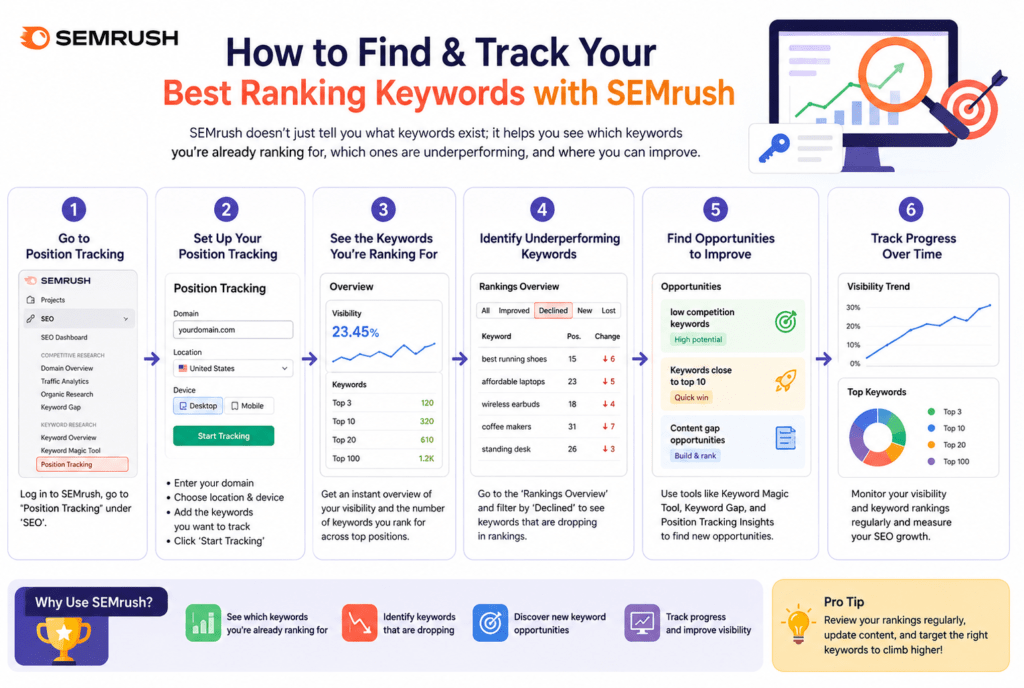
Semrush is one of the top tools for that purpose. It doesn’t tell you what watchwords exist; it makes a difference, you see, which catchphrases you’re as of now positioning for, which ones are performing more poorly, and where you might move forward. Here’s how you can utilize Semrush to discover and track your best positioning keywords.
Begin with the Natural Inquire about Apparatus
- The first thing to do in Semrush is to utilize the Natural Investigate tool.
- This apparatus gives you a clear picture of your website’s current keyword performance.
- To get begun, log into your Semrush account and go to SEO → Competitive Inquire about → Natural Research.
Enter your site space and press look. Semrush will provide you with an outline of your website’s natural execution, including the total number of keywords you rank for, assessed monthly activity, keyword value, and how your positions are displayed over different ranges like positions 1-3, 4-10, 11-20, and more.
Click on the Positions tab to see the full list of keywords.
This is where you’ll discover the most valuable data. You’ll see each watchword Semrush has found that your location positions for, along with its position, search volume, keyword difficulty, and the particular page that positions for it.
Channel for Your Best Entertainers
- Looking at all the catchphrases at once can be confusing.
- The key is to channel down to the most critical ones.
Use the built-in channels to limit your list.
Set the Position channel to 1-10 to focus on the watchwords you’re currently tracking on the starting page. These are your best positioning watchwords and are worth ensuring. Apply a least volume channel (like 100 looks per month) to expel catchphrases that don’t bring much activity. You can too utilize SEMrush’s expectation names — instructive, navigational, commercial, and value-based — to center as it were on keywords that coordinate your commerce goals.
- Once you’ve sifted, you’ll have a list of watchwords that are working well for you.
- Spare this list since you’ll require it for setting up everyday tracking.
Recognize “Low-Hanging Natural Product” Catchphrases
- In addition to your top-performing catchphrases, there are other catchphrases in positions 4-20 that are also valuable.
- These are catchphrases that are near positioning in the top three and seem to make strides essentially with a few optimizations.
- To discover these, set the Position channel to 4-20, sort by look volume from most elevated to least, and see for catchphrases with better than average volume and lower keyword difficulty.
These are the best places to center your optimization endeavors. A few substance upgrades, way better inner joins, or more tightly on-page SEO might offer assistance them rise in rankings. Semrush makes it simple and quick to discover these opportunities.
Set Up Position Following
Finding your catchphrases is the first step.
Following them over time is where Semrush truly sparkles. Its Position Following apparatus checks your rankings every day, so you continuously know if they’re moving forward, remaining the same, or dropping.
To get begun, go to SEO → Rank Following → Position Following and make a new project.
Enter your space, select your area, and gadget sort — track both desktop and portable if required. At that point, glue in the catchphrase list you saved from the Natural Investigate step, and press Begin Tracking.
Semrush will begin collecting positioning information right away.
Within 24 hours, you’ll have a live dashboard appearing in your normal position, perceivability score, assessed activity, and positioning patterns for each keyword you’ve selected.
Perused Your Position Following Dashboard
Once the following is set up, knowing how to peruse the dashboard is truly important.
The Perceivability Score is a key part of the dashboard.
It’s a rate that indicates how regularly your site shows up in search results for your followed catchphrases. A rising perceivability score implies your rankings are getting superior, indeed, if a few keywords are fluctuating.
The Rankings Diagram table appears for each watchword with its current position, the positioning URL, and a drift graph.
Green bolts cruel your positions are moving forward, whereas red bolts cruel they’re going down. Pay extraordinary attention to ruddy bolts for high-volume keywords — those require quick attention.
The Labels include permits you to gather catchphrases by point, page sort, or campaign.
Labeling all catchphrases related to a particular item or substance group makes it less demanding to analyze execution by topic instead of looking through a long, unsorted list.
Set Up Cautions and Week-by-Week Reports
Semrush lets you automate following, so you do not have to check your rankings each day manually.
In Position Following, go to Planned PDF Reports and set up a week-by-week mail summary.
You can send it to yourself, your group, or your clients. Select which measurements to incorporate — like rankings, perceivability patterns, greatest enhancements and drops — and Semrush will send you a clean report on your schedule.
You can moreover make cautions that inform you when a word crosses a position threshold.
For example, set an alarm if any top-10 catchphrases drop below position 15. This early caution framework makes a difference; you capture positioning drops some time recently, and they influence your activity for weeks without you noticing.
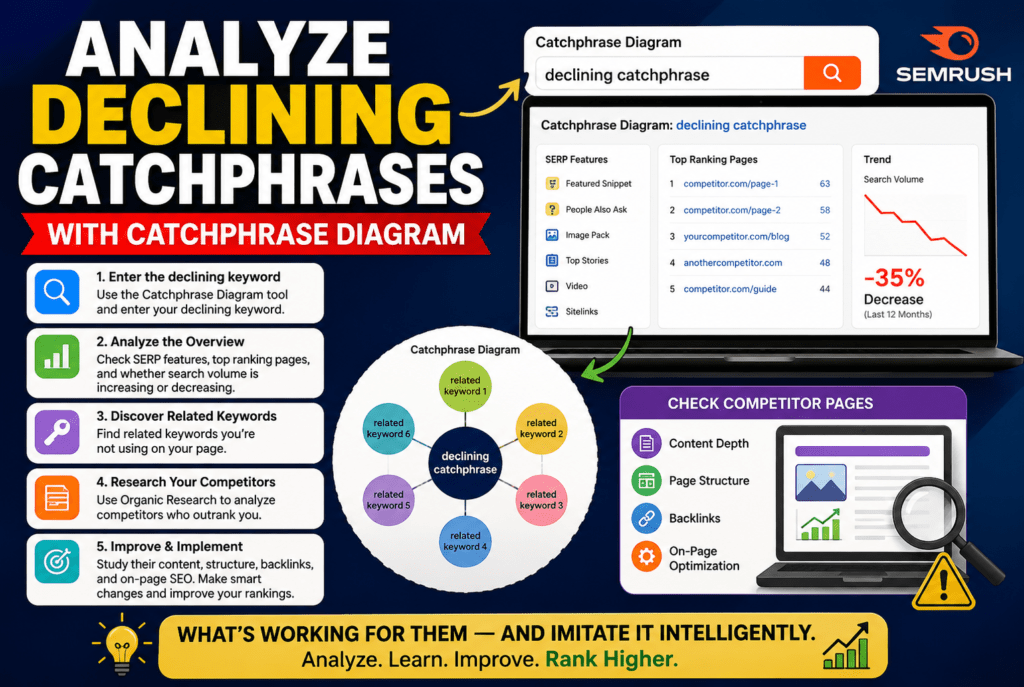
Analyze Declining Catchphrases With Catchphrase Diagram
When you take note that a watchword is performing more regrettable, don’t just see the drift — burrow into why.
Use the Watchword Outline instrument by writing the declining watchword into the look bar.
Semrush will show you what SERP highlights show up for that term, which positions exceedingly, and whether the search volume is increasing or diminishing. It will moreover appear related keywords you’re not utilizing on your page.
If a competitor has beaten you, utilize Natural Inquire about to check their positioning page.
See at their substance profundity, how their page is organized, their backlinks, and their on-page optimization. Semrush gives competitive information that makes a difference. You get what changes you require to make to progress your ranking. What’s working for them — and imitate it intelligently.
Ending
Make Catchphrase Following a Week after week Propensity
The greatest botch SEOs make with Semrush is checking rankings as if after activity has dropped suddenly.
In step, set aside 20–30 minutes each week to see at your Position Following dashboard, check for any changes, and overhaul your content plans as needed.
Semrush provides the information, the channels, the warnings, and the competitive insights.
But the instrument, as it were, conveys dependable results when you utilize it routinely. Begin by checking your current rankings in Natural Inquire about, make a list of the keywords that matter most to your business, and let Semrush oversee the everyday checks.
As time goes on, you’ll begin to take note of openings prior and keep your rankings solid — sometimes a competitor takes them from you.