Freelancing sounds simple in theory: discover clients, do the paintings, get paid. In practice, it’s a method of juggling invoices, cut-off dates, patron messages, record transfers, and your personal sanity, often all earlier than lunch. The proper set of apps does not just make freelancing simpler. It’s regularly the difference between a sustainable enterprise and consistent burnout. Underneath is a sensible breakdown of the gear that definitely earns a permanent spot on a freelancer’s domestic screen.
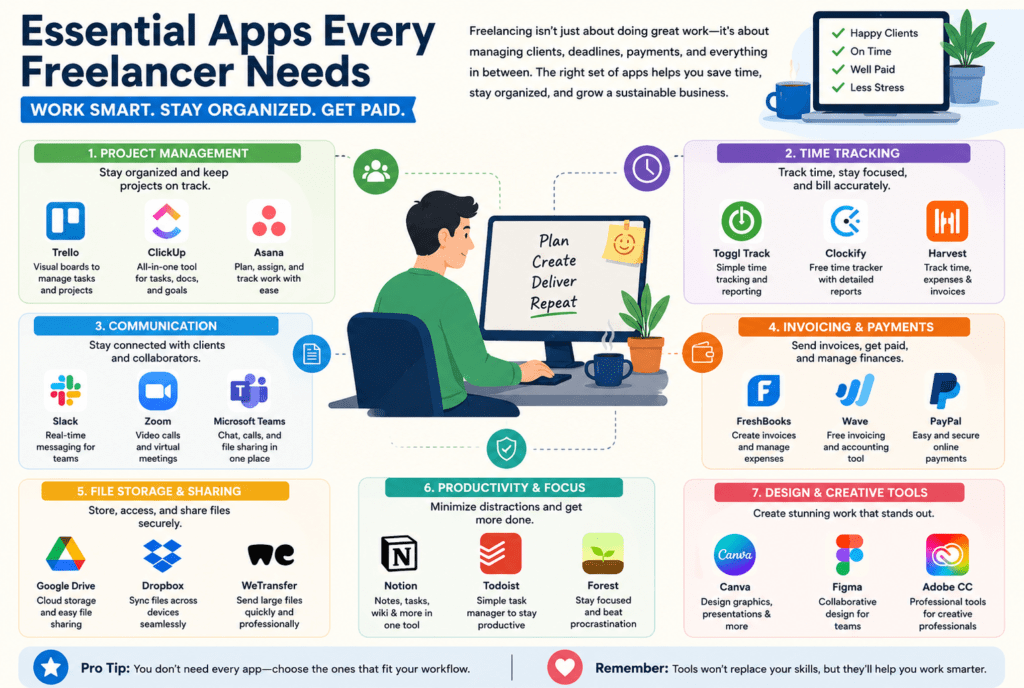
Project and undertaking management
When you’re managing a couple of customers immediately. Relying on reminiscence or sticky notes is a fast way to forget deadlines.
Trello works well for freelancers who work visually. Its drag-and-drop forums make it easy to track where every assignment stands, from “pitched” to “in development” to “brought.” It’s free for personal use and easy enough that there is no learning curve, ingesting into billable hours.
belief has emerged as the cross-to for freelancers who want one workspace for the whole thing. Purchaser trackers, content calendars, invoice logs, or even private desires. It’s more flexible than Trello but takes a bit more setup time in advance.
Asana fits freelancers who collaborate intently with purchaser groups. Since it’s broadly used within companies and makes it smooth to fit into an existing workflow. In preference to asking clients to research a new device.
The right pick relies on how visual versus how dependent you need your workflow to be. Many freelancers begin with Trello for simplicity and migrate to Perception as their patron list grows.
Time tracking and productivity
Whether or not you invoice hourly or just want to realize where your hours truly pass, time monitoring removes the guesswork.
Toggl Tune is the industry’s preferred for a cause. One click starts a timer, and the reporting dashboard breaks down hours by way of customer or project. Which is noticeably useful while it’s time to justify a charge growth or spot which clients are consuming disproportionate amounts of it slowly.
Clockify gives comparable functionality with a greater beneficiant free tier. Making it a solid choice for freelancers just starting out who don’t want another subscription.
For freelancers who struggle with awareness, woodland, or recognition, To-Do combines the Pomodoro method with simple gamification. Which can help whilst the purchaser works, competing with each notification on your phone.
Invoicing and bills
Getting paid on time, each time, is arguably the most stressful part of freelancing, and it’s also the most automatable.
Wave offers loose invoicing and simple accounting. This makes it a sturdy starting line for freelancers who aren’t equipped to pay for a full accounting suite.
FreshBooks is constructed particularly with freelancers and small business corporations in mind. It handles routine invoices, overdue charge reminders, and price tracking without feeling like a business software application.
Clever (formerly TransferWise) merits a mention for freelancers working with worldwide clients. It converts currencies at the actual exchange rate with low expenses. Which matters tremendously, as a bit of each charge could otherwise disappear into financial institution conversion markups.
PayPal nevertheless stays useful as a fallback choice because most customers already have an account and agree with it. Even though its fees are better than those of more freelancer-specific equipment.
Conversation and client control
Professional conversation equipment signals credibility before a purchaser even sees your paintings.
Slack has become a default for customers who want an ongoing channel rather than scattered emails. putting in a devoted workspace consistent with the client (or in step with the assignment) continues conversations, prepared and searchable.
Calendly eliminates the back-and-forth of scheduling calls. Sharing a unmarried hyperlink that indicates real-time availability saves time and appears more professional than a sequence of “Does Tuesday at 3 pm work?” emails.
HoneyBook combines client dating management with proposals, contracts, and invoicing in a single platform, that’s in particular beneficial for freelancers in creative fields like design, images, or copywriting who control the entire customer journey from inquiry to final shipping.
Record storage and Sharing
Massive files, model management, and easy sharing are non-negotiable, whilst paintings include files, designs, or media.
Google pressure stays the most universally conventional alternative considering the fact that almost every purchaser already has a Google account, and real-time collaborative editing in Docs and Sheets eliminates the need for countless e-mail attachments.
Dropbox is preferred with the aid of freelancers in innovative industries for its smoother dealing with of big media documents and more potent model history.
We Transfer fills the distance for one-off huge report transfers, whilst a purchaser doesn’t want ongoing access, only a quick manner to acquire a finished deliverable.
Design and content introduction
Even freelancers in outdoor creative fields come to want fundamental design work for proposals, social posts, or presentations.
Canva has basically grown to be the default visual layout tool for non-designers. Its templates make it feasible to produce consumer-ready snapshots, displays, and social content with no layout background.
Grammarly catches typos and tone problems before they reach a consumer’s inbox, which matters more than it would seem, considering the fact that small errors can undercut perceived professionalism fast.
Loom, we could freelancers record brief display screen-recorded movies as opposed to writing lengthy explanatory emails, which is mainly useful for walking a purchaser thru a deliverable or explaining revisions.
Finance and Tax Control
Freelancers do not have an employer withholding taxes or managing blessings, so tracking profits and charges requires appearing proactively in preference to at tax time.
QuickBooks Self-employed is constructed specially for freelancers and automatically separates business from personal fees, while also estimating quarterly tax bills, which gets rid of a first-rate source of year-round stress.
Mint (or its more recent options, due to the fact that Mint has been winding down) facilitates freelancers to get a broader view of personal finances, useful for budgeting across the income variability that includes freelance work.
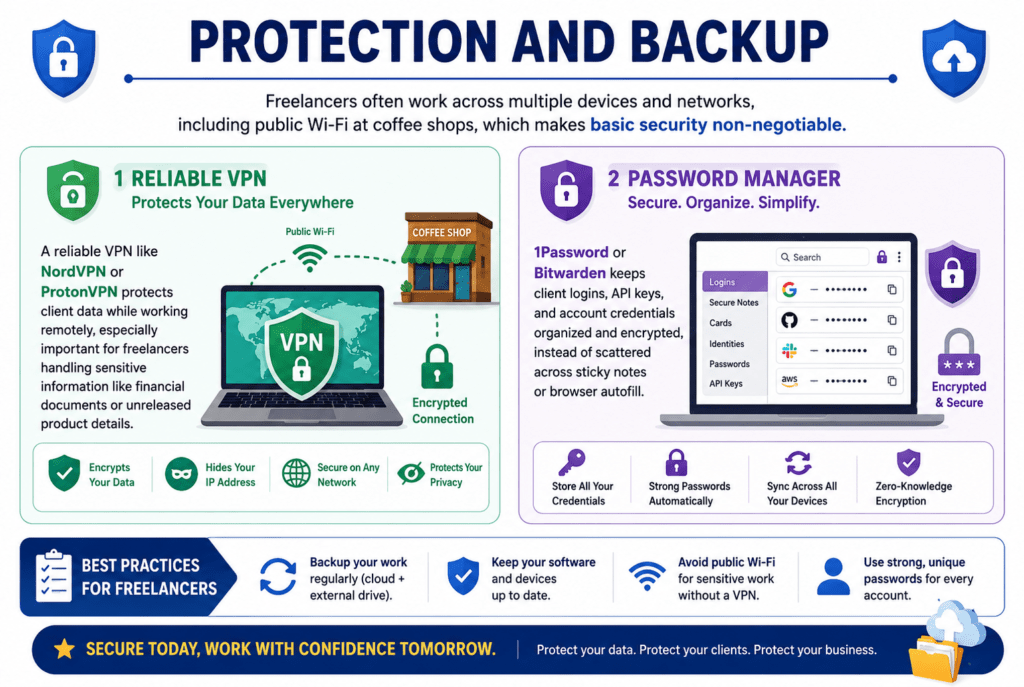
Protection and Backup
Freelancers often paintings throughout more than one device and network, including public wireless at coffee shops, which makes fundamental protection non-negotiable.
A reliable VPN like NordVPN or ProtonVPN protects purchasers’ records while working remotely, especially relevant for freelancers dealing with touchy facts like financial files or unreleased product details.
1Password or Bitwarden keeps client logins, API keys, and account credentials organized and encrypted, in preference to being scattered throughout sticky notes or browser autofill.
Conclusion
The purpose isn’t always to install every app on this list. It’s to pick out one tool according to category that suits your particular workflow. And stay with it long enough to construct actual conduct around it. A freelancer doing copywriting for 5 clients has very different needs than one doing photo layout for fifty small projects a year.
Start lean: a challenge supervisor, a time tracker, an invoicing device, and dependable cloud storage cover the fundamentals. upload specialised equipment as precise ache points show up. In place of amassing apps preemptively. The freelancers who burn out quickest are frequently. Those drowning in gear instead of those who do not have enough of it.